
The jump from dragging colourful blocks in Scratch to writing professional Python code is the single biggest academic hurdle your child will face before they reach Year 10. While many students enjoy gaming, there’s a significant gap between being a tech consumer and becoming a tech creator. If you’ve noticed that school lessons feel basic or inconsistent, finding a high-quality KS3 computing online course is the most effective way to ensure your child doesn’t fall behind. You want to know that their screen time is actually building the logic and computational thinking skills required for future success.
We understand the frustration of seeing a bright student stuck on repetitive ICT tasks when they’re capable of mastering real-world engineering. This guide will help you bridge that gap, transforming hobbyist interest into genuine academic excellence. You’ll discover how a structured curriculum provides a clear, measurable path from simple logic to advanced text-based programming. We’ll explore the essential differences between standard digital literacy and rigorous Computer Science, whilst outlining exactly what to look for in a programme that guarantees GCSE readiness and long-term confidence in an AI-driven world.
Key Takeaways
- Understand why Key Stage 3 serves as the critical academic bridge between primary-level play and the rigorous demands of GCSE Computer Science.
- Learn how to identify a KS3 computing online course that prioritises functional programming skills over purely gamified or basic activities.
- Discover why transitioning from block-based coding to Python is the essential milestone for achieving future-ready technical literacy.
- Evaluate the value of structured syllabus alignment and regular progress reporting to ensure your child remains on track for secondary school success.
- Gain clarity on the distinction between basic ICT usage and the deep computational thinking required for modern software engineering.
Why the Key Stage 3 Computing Curriculum is More Critical Than Ever
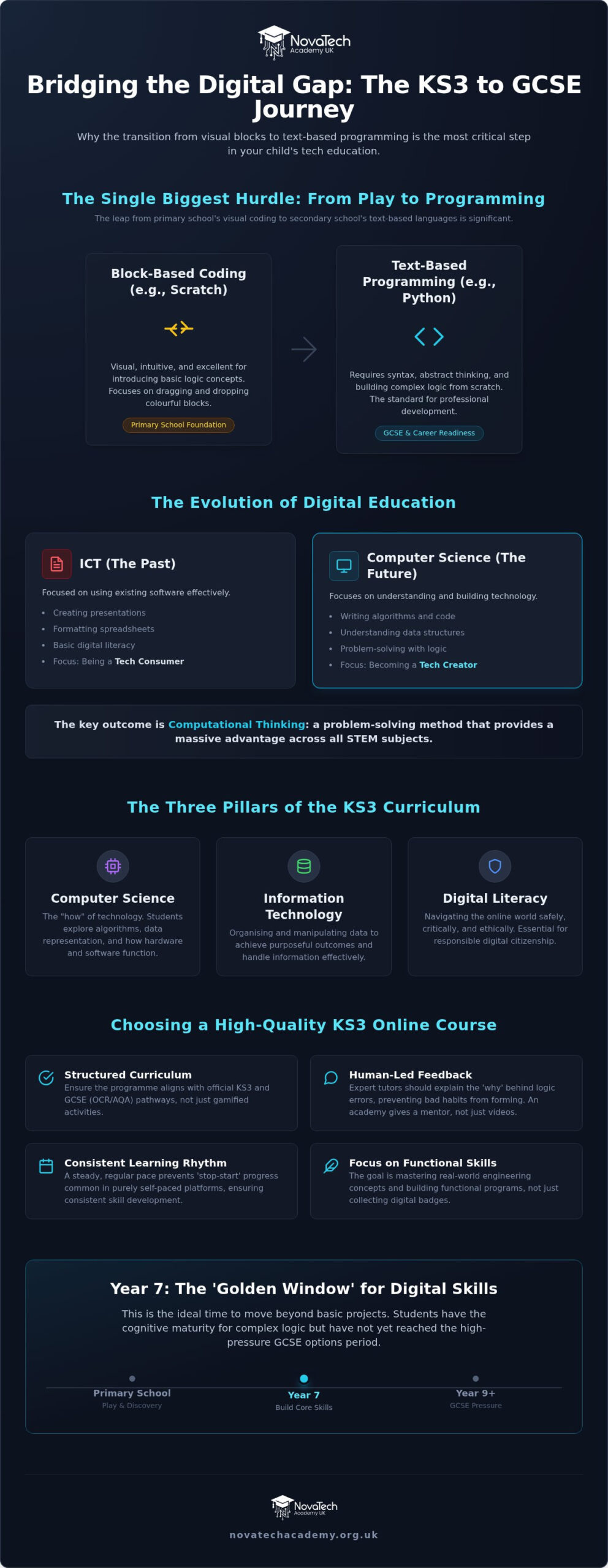
In the UK education system, Key Stage 3 represents a pivotal three-year bridge between the foundational “play” of primary school and the rigorous academic demands of GCSEs. For many parents, this period can feel like a mystery. Whilst primary computing often focuses on simple visual blocks, the secondary curriculum expects a swift transition into technical engineering and abstract logic. It’s during these years that a student’s relationship with technology changes from being a passive user to an active creator.
The old days of “ICT” are gone. Where students once spent hours learning how to format a basic spreadsheet or create a PowerPoint presentation, they now study Computer Science. This shift is profound. It moves the focus from using existing software to understanding and building the software itself. By enrolling in a structured KS3 computing online course, students gain the foundational strength needed to navigate this transition without feeling overwhelmed by the sudden increase in technical depth.
Computational thinking KS3 is the real prize here. It isn’t just about code; it’s a method of problem-solving that breaks complex challenges into manageable steps. This logical framework provides a massive advantage across all STEM subjects, from solving algebraic equations in Maths to analysing data in Physics. As we look toward the 2026 digital skills gap, where demand for technical proficiency continues to outpace supply, early mastery offers a significant competitive edge for future university applications and career paths.
The Three Pillars of KS3 Computing
To provide a well-rounded education, the curriculum is built on three distinct areas of expertise. Each pillar supports the others to create a confident, capable student.
- Computer Science: Students dive into the “how” of technology, exploring algorithms, data representation, and how hardware actually functions.
- Information Technology: This pillar focuses on organising and manipulating data to achieve purposeful outcomes, ensuring students can handle information effectively.
- Digital Literacy: Beyond technical skill, this covers how to navigate the online world safely, critically, and ethically.
Why Year 7 is the ‘Golden Window’ for Digital Skills
Year 7 is the ideal time to move beyond basic Scratch projects. At this age, students have the cognitive maturity to handle more complex logic but haven’t yet reached the high-pressure environment of Year 9 GCSE options. Starting a KS3 computing online course early builds a “digital-first” mindset. It gives them the confidence to use technology as a tool for research and homework, rather than just a platform for gaming. This early start ensures they aren’t just reacting to technology, but mastering it before the stakes get higher. Parents looking to make the most of this window can find detailed guidance in our resource on online computer science for Year 7, which covers everything from curriculum alignment to online safety in 2026.
What to Look for in a KS3 Computing Online Course
Choosing a KS3 computing online course requires looking beyond flashy graphics and digital badges. Whilst gamified apps are excellent for keeping younger children entertained, they often lack the academic rigour required to bridge the gap to secondary qualifications. A functional course must follow a structured path that aligns with the official KS3 computing curriculum, specifically preparing students for the logical depth found in OCR or AQA GCSE pathways.
Consistency is vital. The ideal programme provides the flexibility of online access whilst maintaining a steady learning rhythm. This prevents the “stop-start” progress that often happens with self-paced platforms. Beginners especially need real-time feedback. Automated grading can tell a student their code is “wrong”, but it rarely explains why a specific logic path failed. A high-quality KS3 computing online course ensures that logic errors are caught and explained by humans, not just algorithms.
Qualified Instruction and Personalised Support
There is a massive difference between a “content platform” and an academy with expert tutors. A platform gives you videos; an academy gives you a mentor. Personalised support is vital for correcting those early logic errors that can lead to deep-seated bad habits in programming. Qualified instructors act as a bridge, keeping students motivated when a script doesn’t run as expected. They provide the modern mentor approach that helps a child feel seen and supported. If you’re looking for this level of academic authority, exploring structured tutoring and enrichment can provide the personalised guidance your child needs to truly excel.
Modern Learning Tools and Environment
Modern courses should use professional-grade tools adapted for learners. Browser-based IDEs (Integrated Development Environments) allow students to start coding immediately without complex software installations. These environments should be paired with interactive quizzes and clear progress tracking, giving parents full visibility into measurable growth. We also recommend looking for the following features:
- Safe Community Spaces: Moderated forums where students can engage in collaborative problem-solving.
- Parent Dashboards: Real-time data on lesson completion and assessment scores.
- Industry-Standard Languages: A curriculum that moves quickly towards text-based coding.
Collaborative problem-solving in a secure environment mirrors how real-world software engineering teams operate. This builds essential soft skills alongside technical ones, ensuring your child is ready for the collaborative nature of the modern workplace.
The Great Transition: Moving from Block Coding to Python
Moving from the visual, drag-and-drop world of Scratch to the text-heavy environment of Python often triggers what educators call “syntax shock”. In Scratch, a student can’t easily make a mistake that stops the whole programme from running; the blocks simply won’t click together. In Python, a single missing colon or an extra space can break everything. This transition is the most common point where students lose interest, which is why a well-designed KS3 computing online course must scaffold this journey with care. Python isn’t just a classroom tool; it’s the industry standard for data science and web development, making it the perfect choice for Year 8 and 9 students.
Teaching logic through text requires specific strategies. Instead of just “guessing” where blocks go, students must learn the importance of indentation, the precision of variable naming, and the structure of loops. A good course doesn’t just throw a textbook at a child; it provides a supportive environment where these small errors are seen as part of the learning process. By mastering these mechanics early, students build the resilience needed for more advanced engineering tasks later on.
Why Scratch is Not Enough for Secondary School
Whilst Scratch is brilliant for introducing basic logic, it has clear limitations when handling complex data structures or professional algorithms. Secondary school requires a move towards technical accuracy and abstract thinking. Students must develop typing skills alongside their logic, as the official KS3 computing curriculum mandates the use of at least one text-based language. This shift is also vital for GCSE Computer Science preparation, where students are assessed on their ability to read and write actual code in a written exam format. Without this foundation, the leap to Year 10 can feel insurmountable.
Mastering Python Fundamentals in Years 8 and 9
In the later years of Key Stage 3, the focus shifts to mastering the “big three” concepts: sequencing, selection, and iteration. A robust KS3 computing online course moves beyond abstract theory by having students build real-world applications, such as basic chatbots or currency converters. These projects keep engagement high whilst reinforcing the precision needed for indentation and logic. Computational thinking KS3 is the ability to break down complex problems into manageable, logical steps. By mastering these fundamentals early, students enter their GCSE years with a massive head start, viewing code as a creative tool rather than a frustrating barrier.
Comparing Online Computing Providers: Casual vs. Academic
When searching for the right KS3 computing online course, parents often face a choice between casual, self-paced apps and structured academic academies. Casual resources are excellent for sparking an initial interest in technology, but they often fail to provide the rigorous framework required for secondary school success. An academic approach ensures that the “fun” of coding is backed by the “function” of computer science theory, creating a resilient foundation for the years ahead.
Value is found in progress tracking and measurable outcomes. When evaluating a KS3 computing online course, look for end-of-year assessments and detailed progress reports rather than just digital badges. These metrics are essential for understanding if a student is genuinely mastering computational thinking or simply following a video tutorial. Checking the teacher-to-student ratio is equally important; beginners need to know that a qualified human is available to answer complex questions when automated systems fall short.
Free Resources vs. Paid Academies
Free platforms like YouTube or Khan Academy are fantastic for supplementary learning. They provide quick answers to specific technical questions or “how-to” guides for small projects. However, they lack the accountability of a dedicated student login and a sequential curriculum. A paid academy provides a clear roadmap, ensuring that no critical concepts are missed. This structure significantly increases completion rates because students feel part of a learning community rather than just another viewer in a sea of millions.
Preparing for the GCSE Transition in Year 9
The final year of Key Stage 3 is the most critical time to assess if a course is truly “future-proof” for the 2026-2027 GCSE specifications. A high-quality course must move beyond just coding to cover the theoretical side of the subject. This includes topics like binary representation, hardware components, and networking protocols. These are the areas where many students struggle during their GCSE years if they haven’t been introduced to them early.
Mathematics also plays a larger role as students progress. A strong provider will ensure your child is ready for the mathematical demands of GCSE Computer Science, such as logic gates and data capacity calculations. Choosing a provider that offers a clear “next step” into GCSE and A-Level creates a sense of continuity and confidence. If you’re ready to secure your child’s academic future, explore our KS3 Computing programme to start building that essential foundational strength today.
Future-Ready Learning with NovaTech Academy
NovaTech Academy organises its curriculum with one clear goal: maximum GCSE impact. We don’t treat Key Stage 3 as a separate, isolated phase. Instead, it serves as the essential first step in a cohesive academic journey. By integrating higher-level concepts early, we ensure that the transition to Year 10 is a natural progression rather than a stressful shock. Our KS3 computing online course focuses on building foundational strength through personalised academic support, ensuring every student masters core logic before moving towards advanced programming.
Flexibility is at the heart of our model. We offer year-round admissions, which means you can start your child’s digital journey at any time. You don’t have to wait for a new school term to begin improving their technical skills or correcting inconsistent learning habits. This modern approach respects your family’s schedule whilst maintaining the academic authority needed for top-tier results. We provide a reliable partner for parents who want to move past basic coding and into genuine computer science.
Our Student-Centric Learning Environment
We provide access to high-quality materials designed specifically for modern secondary students. Our tutors act as bridges between technical expertise and academic success. They aren’t just lecturers; they are modern mentors who understand the specific challenges of the UK curriculum. We’re committed to moving students from being passive digital consumers to active digital creators. This shift in mindset is what defines the NovaTech promise, helping learners see technology as a tool for engineering and innovation rather than just entertainment.
Enrolling Your Child for Success
The application process is straightforward and designed to be stress-free for busy families. Whether your child is homeschooled and needs a full curriculum or attends a traditional school and requires supplementary rigour, our courses provide the support they need to excel. We offer a clear, sequential path from KS3 through to GCSE and A-Level Computer Science, ensuring long-term continuity. Take the first step in securing their future and building their confidence in a tech-driven world. You can Apply for the KS3 Computing course today and join a community dedicated to academic excellence and personal growth.
Empower Your Child’s Academic Journey Today
Key Stage 3 is the perfect time to turn a casual interest in technology into a robust academic foundation. By choosing a structured KS3 computing online course, you ensure your child masters the critical shift from visual blocks to professional Python code before the pressure of Year 10 begins. We’ve discussed how a curriculum aligned with specialist AQA and OCR pathways provides the foundational strength required for future success.
NovaTech Academy offers a flexible, digital-first curriculum for 2026 that prioritises personalised tutor feedback on all programming assignments. This professional guidance ensures that logic errors are corrected early, building the resilience and computational thinking skills necessary for GCSE and A-Level excellence. Don’t leave their technical development to chance or basic school lessons that may lack depth.
Secure your child’s digital future-enrol in our KS3 Computing course today. We are here to act as your modern mentor, bridging the gap between current skills and future success. Your child’s journey toward becoming a confident creator starts now.
Frequently Asked Questions
Is an online computing course better than a local tutor?
An online computing course offers specific advantages over a local tutor by providing a structured, digital-first environment that mirrors professional engineering. Whilst a local tutor might offer general help, our specialist curriculum is designed specifically for GCSE readiness. Students benefit from high-quality materials and a consistent learning rhythm that is often harder to maintain with individual sessions. This approach ensures your child develops the technical independence required for higher-level qualifications.
Do I need to buy any special software or a high-end computer for the course?
You don’t need a high-end gaming PC or expensive software to begin. Most modern laptops or desktop computers with a reliable internet connection are perfectly sufficient for our KS3 computing online course. We utilise browser-based Integrated Development Environments (IDEs), which means students can write and run Python code directly in their web browser. This removes the technical barrier of complex installations, allowing your child to focus entirely on mastering their logic and programming skills.
My child has never coded before; can they start the KS3 course in Year 8?
Yes, students can certainly begin their journey in Year 8 even if they have no prior coding experience. Our curriculum is designed to scaffold learning, starting with core logic before progressing to text-based languages. Because we offer year-round admissions, we can tailor the starting point to suit your child’s current ability. This ensures they build the necessary foundational strength at a pace that feels manageable, preventing them from feeling overwhelmed by more advanced concepts later.
How much time per week should my child dedicate to their online computing classes?
We recommend dedicating approximately one to two hours per week to formal lessons, supplemented by short practice sessions. Consistency is far more important than intensity when learning to code. Spending twenty minutes a few times a week to review Python syntax or logic puzzles helps solidify new concepts. This manageable rhythm ensures that computing remains an enjoyable part of their schedule whilst still providing the measurable progress needed for future GCSE success.
Does the KS3 curriculum cover the same topics as the school National Curriculum?
Our curriculum fully aligns with the statutory National Curriculum for England whilst adding significant depth for GCSE preparation. We cover the essential three pillars: Computer Science, Information Technology, and Digital Literacy. However, we place a stronger emphasis on text-based programming and computational thinking than many standard school lessons. This ensures that your child isn’t just meeting basic requirements but is actively building the technical expertise required for the 2026-2027 GCSE specifications.
What happens if my child finds the transition to Python too difficult?
If a student struggles with Python, our “modern mentor” approach provides the personalised support they need to overcome hurdles. Logic errors are a natural part of programming, and our tutors are experts at breaking down complex syntax into manageable steps. We focus on correcting the underlying logic rather than just providing the answer. This builds resilience and ensures your child doesn’t give up when they encounter the “syntax shock” common in text-based coding.
Are there assessments to show me how my child is progressing?
Detailed progress reports and end-of-year assessments are central to our programme. We provide parents with full visibility into their child’s growth, tracking lesson completion and assessment scores in real-time. These metrics help identify specific areas where a student might need extra support or where they are excelling. This measurable data ensures you have total confidence that your investment in a KS3 computing online course is delivering genuine academic results and technical mastery.
Can this course help my child if they are planning to take GCSE Computer Science early?
This course is an excellent choice for students aiming for an accelerated pathway to GCSE Computer Science. By mastering the theoretical side, such as binary and networking, during Key Stage 3, they enter Year 9 or 10 with a significant advantage. We provide a clear “next step” into our GCSE and A-Level courses, allowing ambitious students to progress as soon as they are ready. This foundational strength makes early entry a realistic and stress-free goal.