
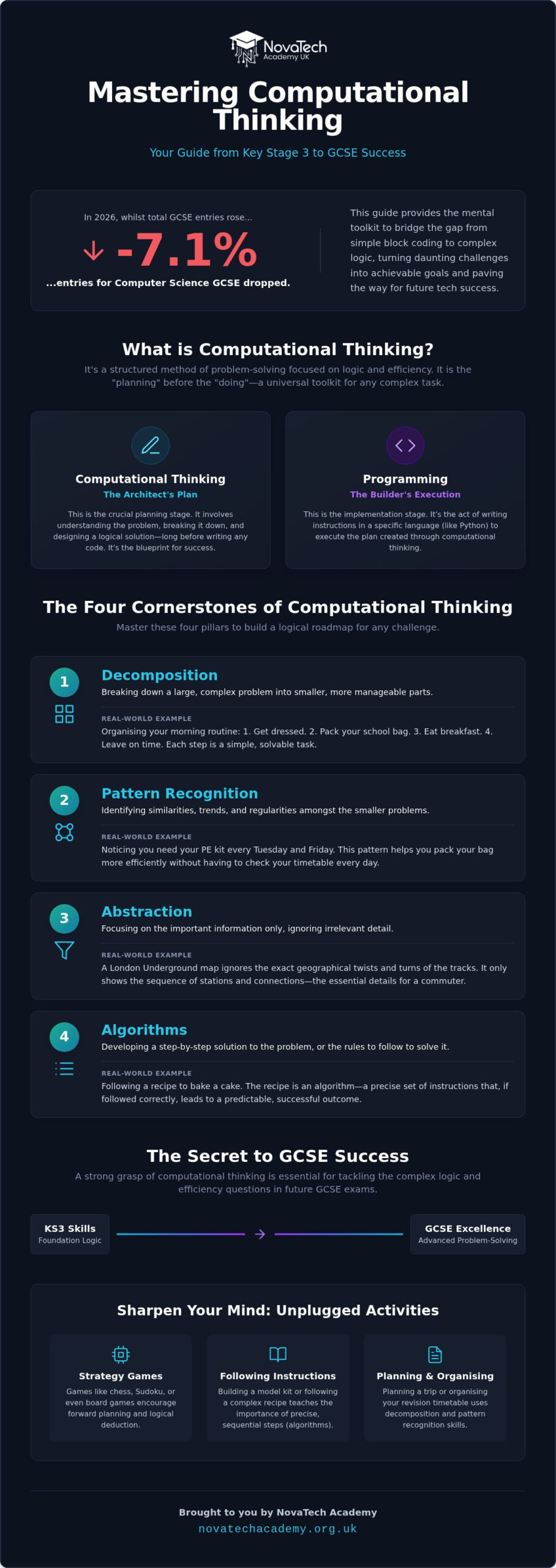
Did you know that whilst total GCSE entries across the UK rose in 2026, the number of students taking Computer Science actually dropped by 7.1%? This statistic suggests that many learners find the jump into technical logic more daunting than it needs to be. For many students and parents, the transition from simple primary school blocks to complex secondary school logic feels like a massive leap. It’s completely normal to feel overwhelmed when abstract concepts start replacing visual games, especially when you’re trying to bridge the gap between Scratch and Python at home.
We believe that every student can excel in this subject with the right mental toolkit. This guide shows you how to master the four cornerstones of computational thinking KS3 to build a solid foundation for your current studies and future GCSE success. By understanding how to break down problems and spot patterns, you’ll gain the confidence to tackle any coding challenge with ease. We’ll explore practical strategies to turn abstract theory into real-world skills, ensuring you stay ahead of the curve whilst preparing for the rigours of the 2026-2027 curriculum and beyond.
Key Takeaways
- Master the core principles of the UK National Curriculum to help your child move beyond basic coding apps and build true technical logic.
- Learn how to use the four cornerstones, such as decomposition and pattern recognition, to break down intimidating projects into simple, bite-sized tasks.
- Discover why a strong grasp of computational thinking KS3 is the secret to tackling the complex logic and efficiency questions in future GCSE exams.
- Identify engaging “unplugged” activities and strategy games that sharpen problem-solving skills and forward planning without needing a computer.
- Explore how a personalised online learning environment fosters the independence and digital confidence required for success in Year 10 and beyond.
What is Computational Thinking at KS3?
At its heart, computational thinking is a structured method of problem-solving that focuses on logic and efficiency. It isn’t just about computers; it’s a precise way of looking at a challenge and figuring out the most effective way to solve it. This approach is often called the “secret sauce” of the UK National Curriculum for Computing because it provides the mental framework needed before a student even touches a keyboard. Understanding What is Computational Thinking? helps students move beyond simply being “users” of technology. Whilst many teenagers are experts at using social media or gaming consoles, computational thinking KS3 encourages them to think like computer scientists by analysing how these systems actually function.
These skills aren’t confined to the computing lab. In Maths, students use these techniques to break down complex algebraic equations into manageable steps. In Science, they apply them to design rigorous experiments or categorise biological data into patterns. It’s a universal toolkit for future-readiness that applies to almost every academic discipline, helping students approach any complex task with a calm, analytical mind.
The Purpose of Logical Reasoning
Logical reasoning acts as the engine for all problem-solving. It allows us to look at a system, understand its rules, and predict what will happen next based on those rules. If a student is building a game, logic helps them anticipate how a character will move when a button is pressed. It is the essential first step in any technical task because it ensures the foundation of the project is sound. Logical reasoning is the ability to explain why something happens.
Computational Thinking vs. Programming
Many people confuse these two terms, but they are quite different. Programming is the act of writing instructions in a language like Python or Java; it’s the “writing” stage of the process. In contrast, computational thinking is the “planning” stage. You can practice these skills with a pen and paper or even whilst organising your school bag. By mastering the plan first, the actual coding becomes much simpler. Students who develop strong computational thinking KS3 skills often find that learning a new programming language feels like a natural next step rather than a confusing hurdle. It’s about being the architect before you become the builder.
The Four Cornerstones: Organising the Core Concepts
To truly master The Four Cornerstones of Computational Thinking, students need to see how these abstract ideas apply to real-world scenarios. These four pillars provide a framework that makes even the most daunting computational thinking KS3 tasks feel manageable. Instead of staring at a blank screen, learners use these concepts to build a logical roadmap for their code. This methodical approach ensures that no problem is too large to solve.
Decomposition and Pattern Recognition
Imagine you’re tasked with designing a complex new video game level. If you look at the whole project at once, it’s easy to feel stuck. Through decomposition, you break that massive project into bite-sized tasks: the background graphics, the character’s movement, the sound effects, and the scoring system. Once you’ve broken it down, pattern recognition helps you work faster. If you notice that three different enemies move in a similar zig-zag pattern, you don’t need to write three separate scripts. You can reuse the logic you’ve already created to save time and effort.
You can even practice this whilst getting ready for school in the morning. Decomposing your routine might look like this:
- Getting dressed for the day.
- Packing your bag based on your specific timetable.
- Eating a healthy breakfast.
- Leaving the house at a set time to catch the bus.
Spotting patterns in which days you need your PE kit or your musical instrument makes the whole morning run more smoothly. Identifying these similarities is a core part of computational thinking KS3 that translates directly to efficient programming.
Abstraction and Algorithms
Abstraction is the art of filtering out the “noise” to focus on what matters. The London Underground map is a classic example. It doesn’t show exactly where the tunnels are under the ground or the precise distance between stations. Instead, it focuses on the connections between lines. For a commuter, the geographic curves of the track are irrelevant; only the sequence of stops matters. This same logic applies to computing. When coding, you ignore the details that don’t affect the immediate goal, such as the colour of a character’s shoes if you’re only trying to calculate their jump height.
Finally, you need an algorithm to put your plan into action. Algorithms must be incredibly precise to avoid “computer confusion.” If an instruction is vague, the computer won’t know how to proceed. An algorithm is a sequence of instructions. Creating a clear, step-by-step recipe for your code is what separates a successful project from a buggy one. If you’re looking for a way to sharpen these skills, our KS3 Computing courses provide the personalised support needed to turn these concepts into practical, future-ready abilities.
Why Computational Thinking is the Secret to GCSE Success
The transition from Year 9 to Year 10 marks a significant shift in academic expectations. For many students, this is the point where computing moves from a creative subject to a rigorous science. A solid grasp of computational thinking KS3 ensures that learners don’t just survive this transition; they thrive. According to the official Why Computational Thinking is the Secret to GCSE Success guidelines, the curriculum is designed to foster a deep understanding of how digital systems work. This foundation is vital because exam boards like AQA and OCR dedicate nearly half of their GCSE marks to problem-solving and algorithmic logic in Paper 1. In the 2026 exams, 29.9% of students achieved a grade 7 or above, a slight increase from the previous year, proving that those with strong foundations are consistently reaching the top marks.
Many students experience “coding anxiety” when faced with a blank Python shell. They worry about syntax errors and brackets. By prioritising logic first, we remove that barrier. If a student can solve the problem on paper, the code is just a translation. This mindset is particularly useful for higher-tier GCSE questions where the solution isn’t immediately obvious. Mastery of computational thinking KS3 acts as a bridge, turning intimidating exam questions into manageable puzzles.
Preparing for the GCSE Specification
As students move into Key Stage 4, simple concepts like decomposition evolve into complex topics such as Big O notation, which measures the efficiency of an algorithm. Learning to “Dry Run” algorithms on paper is a skill that starts in Year 7 but becomes essential for GCSE success. This process involves tracing the path of data through a set of instructions to spot errors before they happen. It builds the resilience needed for complex programming projects, as students learn that “bugs” are just logic errors waiting to be solved. This methodical approach is the hallmark of a high-achieving computer scientist.
Future-Proofing Digital Skills
Employers today value “computational thinkers” over those who can simply write a few lines of code. This is because languages like Python or Java may change, but the ability to think logically is permanent. These skills are directly linked to high-growth careers in AI and Data Science, where the ability to spot patterns in massive datasets is a core requirement. At NovaTech Academy, our GCSE Computer Science and KS3 Computing courses align directly with these future academic goals. We position our tutors as modern mentors who help students see the long-term value in their current studies, ensuring they are ready for the digital challenges of the 2030s.
Practical Strategies to Improve Your Logical Mind
Developing a sharp analytical mind is like training for a sport; it requires consistent, varied practice. Whilst we often associate computational thinking KS3 with computer screens, some of the most effective ways to sharpen your logic happen “unplugged”. Engaging in activities away from the PC helps students internalise concepts without the distraction of syntax errors. One powerful method is explaining your logic out loud. When you describe a solution to a parent or friend, you’re forced to organise your thoughts into a coherent sequence. This verbalisation often reveals hidden gaps in your reasoning that you might miss whilst working silently.
Starting small is the key to long-term success. Small coding projects in Scratch or Python provide the perfect playground to see this logic in action. Instead of trying to build a massive application, start with a script that performs a single, specific task. This hands-on approach allows you to see immediate results. It helps you understand the direct relationship between your instructions and the computer’s behaviour. For students in Year 8 looking to build on these foundations, our online computer science for Year 8 checklist provides a structured roadmap of the essential skills needed to stay ahead of the 2026 curriculum.
Learning Through Gamification
Games are far more than just entertainment. They’re sophisticated simulators for logical reasoning. Minecraft, for instance, requires players to decompose massive construction projects into individual blocks and resources. Similarly, Sudoku is a masterclass in pattern recognition and elimination logic. If you’re interested in “modding” games, you’re already practising high-level abstraction. You have to decide which parts of the original game’s code need to change and which can stay the same. We always encourage a growth mindset. When an algorithm fails or a mod crashes, it’s just a data point that helps you refine your next attempt.
Effective Home Learning Habits
Success in a digital-first environment depends on structure. Setting up a dedicated study space helps signal to your brain that it’s time to focus. Before you even touch the keyboard, try using flowcharts to visualise the problem. This creates a clear map of your algorithm, making the transition to code much smoother. Remember that regular, twenty-minute practice sessions are significantly more effective than “cramming” for hours once a week. This consistent exposure helps computational thinking KS3 skills become second nature. To build this foundation with professional support, you can enrol in our KS3 Computing programme and learn from experts who act as modern mentors.
How NovaTech Academy Transforms KS3 Learners
Static resources and pre-recorded videos provide information, but true mastery of computational thinking KS3 requires active engagement. We provide a personalised roadmap that moves beyond passive learning. Our digital-first approach allows students to develop these skills in the environment where they will eventually apply them. By learning online, students naturally build the digital confidence and independence required for modern academic success. They learn to manage their own digital workspace, a skill that is just as important as the code they write. Our tutors act as modern mentors, focusing on bridging the gap between simply “knowing” a definition and being able to “do” the work in a real-world context.
Flexibility is at the core of our academy. We understand that busy family schedules require a learning model that fits around life. Our students can access high-quality tuition from anywhere, ensuring that geographic location is never a barrier to elite computer science education. This freedom allows learners to approach their studies with a calm, focused mindset, which is essential for grasping complex logical concepts.
Tailored Support for Every Student
Every learner processes logic differently. Some students are visual thinkers who thrive on diagrams, whilst others prefer a text-based, step-by-step explanation. We adapt our teaching styles to suit these individual needs. In a live online session, the value of immediate feedback cannot be overstated. When a student makes a logical error in an algorithm, our tutors spot it in real-time. We guide them through the “why” of the mistake, helping them correct their own reasoning rather than just giving them the answer. This personalised attention is particularly vital during the transition from block-based coding like Scratch to text-based languages like Python. We ensure this leap feels like a natural progression rather than a daunting hurdle. Parents looking for structured support can explore our guide to online computer science for Year 7 to understand how to best support their child from the very start of secondary school.
Enrolling in Our KS3 Computing Course
A NovaTech Academy online class is an interactive experience designed to spark curiosity. We don’t just teach for the current term; we build the foundational strength required for the rigours of GCSE Computer Science. Our curriculum is specifically designed to align with the 2026-2027 UK standards, ensuring your child is ahead of the curve. By the time our students reach Year 10, they have already developed the resilience and analytical skills needed to excel in higher-tier exams. We focus on creating future-ready thinkers who are prepared for the digital challenges of tomorrow. If you’re ready to give your child a head start, Discover our KS3 Computing courses and enrol today to begin their journey toward technical mastery.
Prepare for a Future Without Limits
Mastering computational thinking KS3 is about much more than passing a Year 9 test; it’s about equipping your child with a logic-based toolkit that lasts a lifetime. By breaking down complex tasks and spotting patterns early, students transform from passive technology users into innovative creators. This foundational strength ensures they approach Key Stage 4 with the confidence needed to excel in rigorous exam environments, particularly when tackling the algorithmic challenges of GCSE Paper 1. These skills aren’t just for the classroom; they’re the building blocks of a successful career in a digital world.
We know that every learner’s journey is unique. Our curriculum-aligned online courses provide the structure and depth required to bridge the gap between simple block coding and advanced text-based programming. With support from our qualified expert tutors, your child can develop these vital skills in a supportive, digital-first space. We offer flexible learning for busy families, making it easier than ever to prioritise academic growth alongside a hectic schedule. Enrol your child in our KS3 Computing course to build a future in tech and watch their digital confidence soar. We’re here to guide them every step of the way.
Frequently Asked Questions
What are the four cornerstones of computational thinking?
The four pillars are decomposition, pattern recognition, abstraction, and algorithms. Decomposition involves breaking a complex problem into smaller parts, whilst pattern recognition looks for similarities within those parts. Abstraction involves removing unnecessary details to focus on what matters, and algorithms are the step-by-step instructions used to solve the problem. These concepts form the basis of computational thinking KS3 and are essential for effective problem-solving in any technical field.
Is computational thinking only for computer science?
No, these skills are universal techniques applicable to many different subjects. In Maths, students use decomposition to solve multi-step equations. In Science, they use pattern recognition to analyse experimental data. Even in English, abstraction helps identify the core themes of a complex text. It is a mental framework that improves analytical reasoning across the entire curriculum, making it a valuable life skill that extends far beyond the computer lab.
How can I help my child with KS3 computing at home?
You can support your child by encouraging them to explain their logic during everyday tasks. Ask them to deconstruct a recipe or plan a travel route using a logical sequence. Providing a dedicated space for online learning and encouraging short, regular practice sessions also makes a significant difference. If they find the transition to text-based coding difficult, a structured programme with personalised support can provide the expert guidance they need to excel.
Can you learn computational thinking without a computer?
Yes, “unplugged” activities are an excellent way to build these skills away from a screen. You can practice algorithmic thinking by writing precise instructions for a board game or use pattern recognition whilst sorting a collection of items. These activities help students internalise the logic behind computational thinking KS3 without the frustration of technical bugs. Mastering the thought process first makes the eventual transition to using a computer much smoother and more intuitive.
What is the difference between an algorithm and a programme?
An algorithm is a conceptual plan, whilst a programme is the implementation of that plan. Think of an algorithm as a recipe written in plain English that anyone can follow. A programme is that same recipe translated into a specific code, like Python, so a computer can execute the instructions. You must have a clear, logical algorithm before you can write a successful programme, as computers require absolute precision to function without errors.
Why is abstraction important in problem-solving?
Abstraction allows you to manage complexity by ignoring irrelevant details. When you focus only on the information that matters for the specific problem you are solving, you avoid becoming overwhelmed by unnecessary data. For example, if you are calculating the time it takes to travel between two stations, the colour of the train is irrelevant. By stripping away these details, you create a clearer and more efficient path toward an accurate and logical solution.
How does computational thinking help with GCSE revision?
It helps students break down the massive GCSE syllabus into manageable chunks. By using decomposition, a student can divide a subject into individual topics and sub-topics, making revision feel less daunting. Pattern recognition allows them to spot common question types in past papers, whilst algorithmic thinking helps them develop a step-by-step plan for their study sessions. These techniques build the resilience and organisation required to achieve top grades in Year 11 and beyond.
When should my child start learning these skills?
While basic logic begins in primary school, the formal development of these skills is most critical at the start of secondary education. Starting in Year 7 allows students to build a strong foundation before the academic pressure of Key Stage 4 begins. Early mastery ensures they are comfortable with abstract concepts and logical reasoning well before they choose their GCSE options. For parents navigating this pivotal stage, our dedicated resource on online computer science for Year 7 offers practical guidance on setting your child up for success from the very beginning. This proactive approach prevents coding anxiety and sets them up for long-term success.